Comparison
No-Drill Blinds Compared: How LazBlinds Stacks Up Against the Alternatives
Adhesive paper shades, custom drilled blinds, tension rods, plain curtains: everyone selling "easy window coverings" means something different. Here is an honest, category-by-category comparison, including the windows where LazBlinds is the wrong choice.
I answer the support email at LazBlinds, which means I spend a lot of my week comparing us to everything else on the shelf. People write in mid-decision: "I'm also looking at the peel-and-stick paper ones, what's the difference?" or "Why not just get custom blinds from the big-box store?" These are good questions, and the honest answers do not all point at us.
So this is the comparison I would give a friend. Five ways to cover a window without a contractor, what each is genuinely good at, what it quietly costs you, and, the part most brand pages skip — the specific situations where you should buy something other than a LazBlinds shade. If you leave this article having bought a tension rod and a curtain because that is what your window needed, I have done my job.
The five ways to cover a window on your own
Ignore brand names for a second. Strip the market down and there are really five categories a normal person can install themselves in an afternoon:
- Adhesive paper / temporary shades. Pleated paper or thin fabric that sticks up with adhesive tabs. Cheap, disposable, meant as a stopgap.
- No-drill spring-rod shades. Real shades held by an internal tension rod wedged inside the frame. This is the LazBlinds category.
- Custom drilled blinds, measured-to-order blinds from a big-box or online configurator, mounted on screwed-in brackets.
- Tension-rod curtains, fabric panels on a spring rod, no hardware in the wall.
- Drilled curtain rods — the traditional rod-and-bracket over the window.
Each solves the window differently. Let us take them in turn, honestly.
Adhesive paper shades: the honest stopgap
You know these: the flat pleated paper shades sold in a slim box, stuck up with adhesive strips, trimmed to width. They have real virtues. They are the cheapest thing on this list by a wide margin, they go up in minutes, and for a brand-new apartment where you need privacy tonight and will decide on real shades later, they are genuinely the right call.
What they cost you is longevity and looks. Paper creases, yellows, and tears; the adhesive gives out over a season or two, especially in a humid room or a hot window. Raising and lowering them repeatedly is exactly what wears them out fastest, so many people just leave them at one height, which rather defeats the point. They are a stopgap that knows it is a stopgap. If you want something you will still like in three years, keep reading. If you need something for the next three months, this is your box.
No-drill spring-rod shades: what LazBlinds actually is
This is our category, so let me be precise about what it is rather than just cheerlead. A no-drill spring-rod shade is a full, real window shade, honeycomb cell, vinyl slat, bamboo weave, held up by a spring-loaded tension rod that pushes against the inside faces of your window frame. No adhesive, no screws, no anchors. You compress the rod, seat the shade in the recess, and let it expand. Thirty seconds, and it grips hard enough to stay put for years.
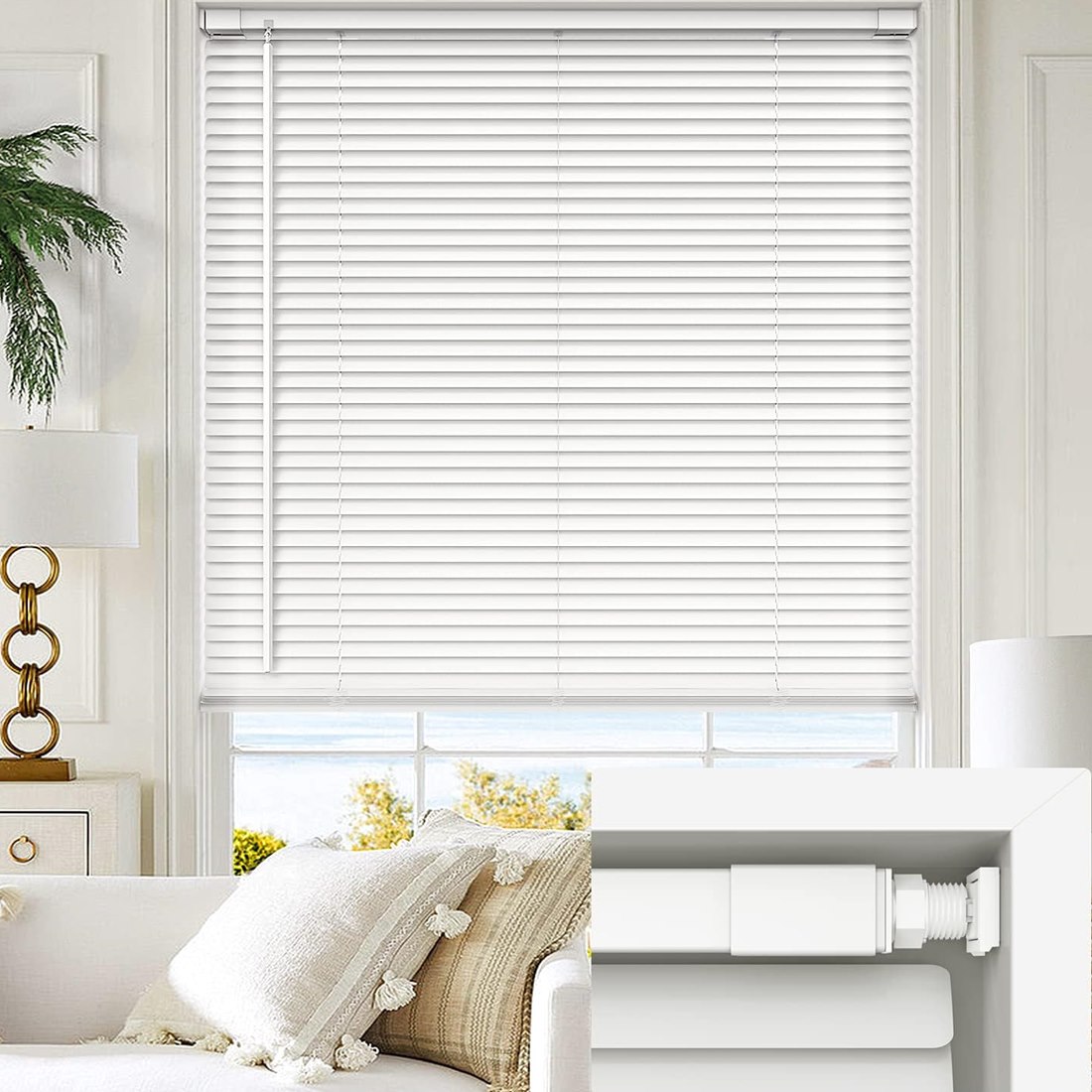
The upside is the pitch: you get a proper shade with proper materials and proper insulation, it costs you nothing in wall damage, and it comes back out in seconds when you move — so it moves with you instead of staying behind for a landlord. Our whole product range is built on that one mechanism, from a $22.49 mini blind to an insulating Top Down Bottom Up Cellular Shade.
The honest limit, and it is a real one, is that a spring rod needs something sound to push against. It is inside mount only. Your window has to have a recess at least about an inch and a half deep, and the frame surface has to be solid: firm wood, painted-but-intact drywall return, tile. On crumbling plaster, flaking paint, or a window with no recess at all, the rod has nothing to grip and it will creep or fall. When people write to me disappointed, it is almost always this: a shallow or damaged opening that no tension mount could have held. Which is the perfect segue to the option that does not care about any of that.
One shade in our range breaks the rule
The 100% Blackout Roller Shade does not use a spring rod. It mounts on adhesive hook-and-loop tape and will stick to a flat frame face. So if your window has no usable recess, you are not locked out of no-drill entirely; you are just pointed at the roller instead of the cellular shades.
Custom drilled blinds: better fit, real holes
Here is where I send people away from us regularly. If you own your home, if your windows are an odd shape, or if you simply want the cleanest possible custom fit, drilled blinds from a big-box configurator or a brand like the ones at the home centers are genuinely a better product for you. Measured to the exact opening, mounted on screwed brackets, they fit like they were built for that window, because they were.
What you pay is threefold: real holes in the frame (two to six screws per window), a slower install involving a drill, a level, and wall anchors, and usually a higher price and a lead time while they are made to order. None of that is a dealbreaker if you own the place. All of it is a dealbreaker if your lease counts nail holes at move-out. The comparison is not "better vs worse". It is "permanent-and-precise vs removable-and-instant." Pick the axis that matches your life.
| LazBlinds no-drill | Adhesive paper | Custom drilled | Curtains (tension rod) | |
|---|---|---|---|---|
| Install time | 30 sec – 1 min | 5–10 min | 20–40 min + tools | 5–10 min |
| Wall damage | None | None (adhesive residue) | 2–6 holes / window | None |
| Real shade materials | Yes, cell, vinyl, bamboo | No, thin paper/fabric | Yes | Fabric only |
| Insulation | Honeycomb air layer | Minimal | Depends | Good with thermal lining |
| Lifespan | Years | Months | Years | Years |
| Comes with you when you move | Yes, in seconds | No | Rarely worth re-drilling | Yes |
| Needs a sound inside recess | Yes (its main limit) | No | No | No |
Curtains and tension rods: the fabric alternative
Curtains solve a different problem, and sometimes it is your problem. A fabric panel on a spring tension rod puts zero holes in the wall and works on essentially any window regardless of recess depth, which is exactly where spring-rod shades struggle. With a thermal lining, curtains insulate well. They soften a room in a way hard shades cannot, and they scale to enormous windows and sliding doors that no mini blind will cover.
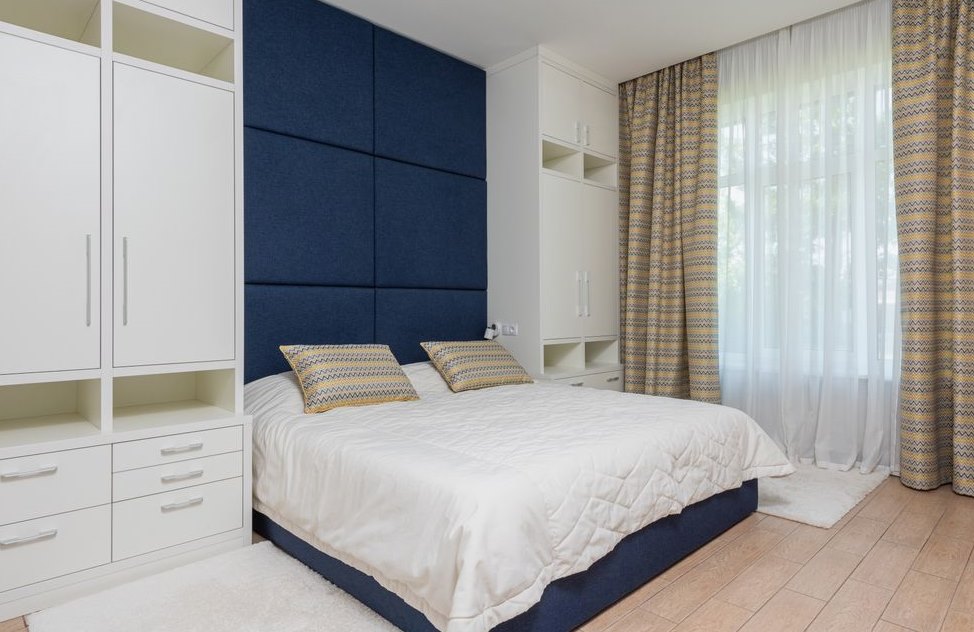
The costs are equally real. A tension rod heavy enough for real curtains can sag or slip over a wide span. Curtains leak light around the sides and top in a way a fitted blind does not, so "blackout curtains" are rarely as dark as a coated roller. And they give you far less granular light control. You get open or closed, not the slat-by-slat adjustment of a 1" Vinyl Mini Blinds or the sky-in-privacy-below trick of a top-down cellular. For a bedroom you can absolutely layer both: a blackout shade on the glass for darkness, curtains outside it for looks and softness.
The category I left off the shelf: motorized and smart shades
One more option deserves an honest mention, because people ask: motorized and smart shades. These raise and lower on a rechargeable or wired motor, controlled from a remote, an app, or a voice assistant, sometimes on a sunrise-and-sunset schedule. For a tall window you cannot easily reach, a bank of windows you want to move together, or an accessibility need where physically pulling a shade is difficult, they are genuinely wonderful, and I will not pretend a manual shade competes on convenience there.
What they cost is money and complexity. Motorized shades run several times the price of a manual one, they usually assume a drilled or bracketed install, and they add batteries to charge or wiring to run and firmware that can misbehave. For the overwhelming majority of ordinary windows in an ordinary rental, a motor is solving a problem you do not have. The honest rule: if reach or a genuine accessibility need is the issue, look hard at motorized; if it is just novelty, a cordless manual shade you push up and pull down does the same job for a fraction of the cost and never needs charging. Our top-down-bottom-up Top Down Bottom Up Cellular Shade, notably, gives you a lot of the light-control flexibility people buy motors for, with no electronics at all.
The cost that is not on the price tag
Sticker price is a bad way to compare window coverings, because the categories have wildly different lifespans and hidden costs. Let me lay out the real math over, say, five years in a rental.
Adhesive paper shades are cheapest up front and most expensive over time, because you replace them repeatedly. They are measured in months, not years. Custom drilled blinds are expensive up front, last for years, but carry two hidden costs a renter feels: the lead time and drill work to install, and the very real possibility of losing part of a security deposit over the holes, or paying to patch and repaint on the way out. Curtains sit in the middle, with the tension-rod versions cheap and the drilled-rod versions adding hardware and holes.
No-drill spring-rod shades land in a specific sweet spot for the renting case: mid-range up front, years of lifespan, and — the part that actually saves money, zero deposit risk and zero move-out repair, plus you physically take them to the next place instead of buying again. A shade that moves with you three times has effectively divided its price by three. That is the calculation that does not fit on a price tag, and it is the one that makes the category make sense for people who move every year or two.
What leases actually say
Most standard residential leases prohibit "alterations" or "holes in the walls" without written permission, and many explicitly list window treatments. Landlords vary in how strictly they enforce it, but the safe reading is simple: anything you screw or drill in, you may be asked to remove and repair. A no-drill shade sidesteps the entire clause because there is nothing to remove and nothing to repair, which is the whole reason this product category exists.
Four real scenarios, four different answers
Abstract comparison only gets you so far. Here is how I actually talk people through it when they describe their situation in an email.
The studio apartment, one big street-facing window
Privacy is the whole problem here, and it is a daytime-versus-nighttime problem. A top-down-bottom-up Top Down Bottom Up Cellular Shade is often the single best answer in the whole range for this: drop the top to let in sky and daylight while the lower half keeps the sidewalk from seeing your bed. If the window is unusually wide, a curtain on a tension rod may cover it better than a single shade: measure first and let the Fit Check tool tell you whether one shade fits the span.
The nursery
Two non-negotiables: darkness for naps, and absolutely no cords. The 100% Blackout Roller Shade covers the darkness, and being cordless covers the safety. This is the one room where I would not compromise on true blackout. A "room darkening" filtering shade will leave a napping baby's room too light, and you will feel it at 2 p.m. Pair the roller with anything decorative you like on top.
The home office with a monitor
The enemy is glare on the screen, not light in general — you want the room bright but the hard stripe of sun gone. This is exactly the softened job, and a light-filtering Cordless Cellular Shade is purpose-built for it: even, glare-free light all day, plus the insulation bonus if you work next to a cold or hot window. A blackout shade here would be a mistake; you would spend the day with the lights on.
The rental with beautiful but non-standard windows
Old buildings have gorgeous windows that are never square and sometimes have shallow or damaged frames. If the recess is sound, measure all three points and order off the narrowest. If the recess is shallow, crumbling, or missing entirely, this is where you leave the spring-rod category: the adhesive 100% Blackout Roller Shade or a tension-rod curtain is your friend. There is no shame in it; physics is physics, and I would rather you buy the thing that holds.
So which should you actually buy?
Let me collapse all of it into plain recommendations. Find your situation and go.
- You rent, and the window has a normal recess. No-drill spring-rod shades are made for exactly you. Real materials, real insulation, zero damage, out in seconds on moving day. Start at the shade lineup.
- You rent, but the window is shallow, damaged, or recess-free. The 100% Blackout Roller Shade on adhesive tape, or curtains on a tension rod. Skip the cellular shades: the rod has nothing to grip.
- You own the home and want a flawless custom fit. Drilled blinds from a configurator. Buy the holes; you are allowed to.
- You need privacy tonight and will decide properly later. Adhesive paper shades. Cheap, fast, disposable, honest about it.
- Huge window or a sliding door. Curtains, probably with a thermal lining.
The measuring mistake behind almost every return
Since I process the returns, let me tell you what causes most of them, because it is almost never the shade and almost always the tape measure. The single most common mistake is measuring the window opening once, at the widest point, and ordering off that number. Frames are not square, especially in older buildings, and the top, middle, and bottom of the same opening routinely differ by a quarter-inch or more. Order off the widest spot and the shade will not seat where the opening is narrower; order off the narrowest and it drops in everywhere.
So the rule is three measurements and the smallest wins. Measure the inside width of the recess at the top, the middle, and the bottom, write down all three, and order for the narrowest. Do the same for depth to confirm you actually have the inch-and-a-half a spring rod needs to seat. It takes ninety seconds and it is the whole difference between a shade that grips for years and one that comes back in the box with a disappointed note. The Fit Check tool does the deduction arithmetic once you have that narrowest number, but the number has to be honest, and honest means the smallest of three.
Notice that we are the right answer for one specific, very common person: a renter with ordinary windows who wants a real shade and their deposit back. We are emphatically not the right answer for a homeowner chasing a custom fit or someone with a recess-free wall. A brand that pretended otherwise would just generate returns and grumpy emails, and I am the one who reads the grumpy emails.
If you have landed on the no-drill category, two things will save you a reorder: measure your opening in three places and trust the narrowest, and run that number through the Fit Check tool before you buy. Most of the sizing mistakes I see are a single measurement taken once, at the widest point, on a frame that is not square. Ninety seconds with a tape measure is the whole difference between a shade that grips for years and one that comes back in the box.
Three myths worth clearing up before you decide
After enough support emails, the same misunderstandings surface again and again. Clearing them up saves people from buying the wrong category for the wrong reason.
"No-drill means flimsy." This is the big one, and it is backwards. The no-drill part is only the mount; the shade itself is a full honeycomb cell, real vinyl slat, or genuine bamboo weave. The same materials you would get on a drilled blind. What holds it up is a tuned spring rod, not weak construction. The mechanism is clever, not cheap. What is actually flimsy is the adhesive paper category, which is a different thing entirely.
"Room darkening is basically blackout." It is not, and the labels blur it on purpose. Only a true 0%-openness coated fabric blacks a room out; everything sold as "room darkening" is filtering fabric that will still be clearly light at midday. If darkness is the requirement, a nursery, a shift worker's bedroom — insist on actual blackout and accept nothing softer.
"If it fits the width, it fits." Width is the hard part, but recess depth quietly disqualifies more windows than width does. A spring-rod shade needs roughly an inch and a half of depth to seat inside the frame. Shallow bay windows, some casement frames, and windows with obstructions in the recess can be too shallow no matter how perfect the width is. Check the depth before you fall in love with a cellular shade, and if the recess is not there, remember the adhesive roller does not need one.
The bottom line
Covering a window without a contractor is a solved problem. There are five good solutions, and the only mistake is using the wrong one for your situation. Adhesive paper for a stopgap. No-drill spring-rod shades for a renter with normal windows who wants the real thing and their deposit back. Drilled blinds for an owner chasing a custom fit. Curtains for big or recess-free windows. A motor only when reach or accessibility genuinely demands it.
We make one of those five, and we make it for one specific, extremely common person. If that person is you, measure three times, trust the narrowest number, run it through the Fit Check tool, and go. If it is not you, I hope this saved you a return. Either way, curious how the shade that grips your frame is actually engineered? Our next guide takes one apart: how a no-drill shade is made, from fabric roll to spring rod.
Ready to measure your window? The Fit Check tool does the deduction math, or browse the full shade lineup.